Case study · The Lazy Viber
I built a business that writes, translates, sells and explains its own products. Here is how I think.
The Lazy Viber is my second business. I built it, and I run it. It sells one-time guides that replace software subscriptions with Ai: buy once, keep it for good.
01 The store, in three numbers
Large enough to need a system, not a staff.
- 115 guides on the shelf See them on the live store ↗
- 7 languages it speaks beyond English Read the store in Spanish ↗
- 35 essays on the journal Read the journal ↗
As of October 2026, from the store catalog. Plus 50 small tools in the Dollar Bin ↗. Tap any number to see it live.
02 The brand
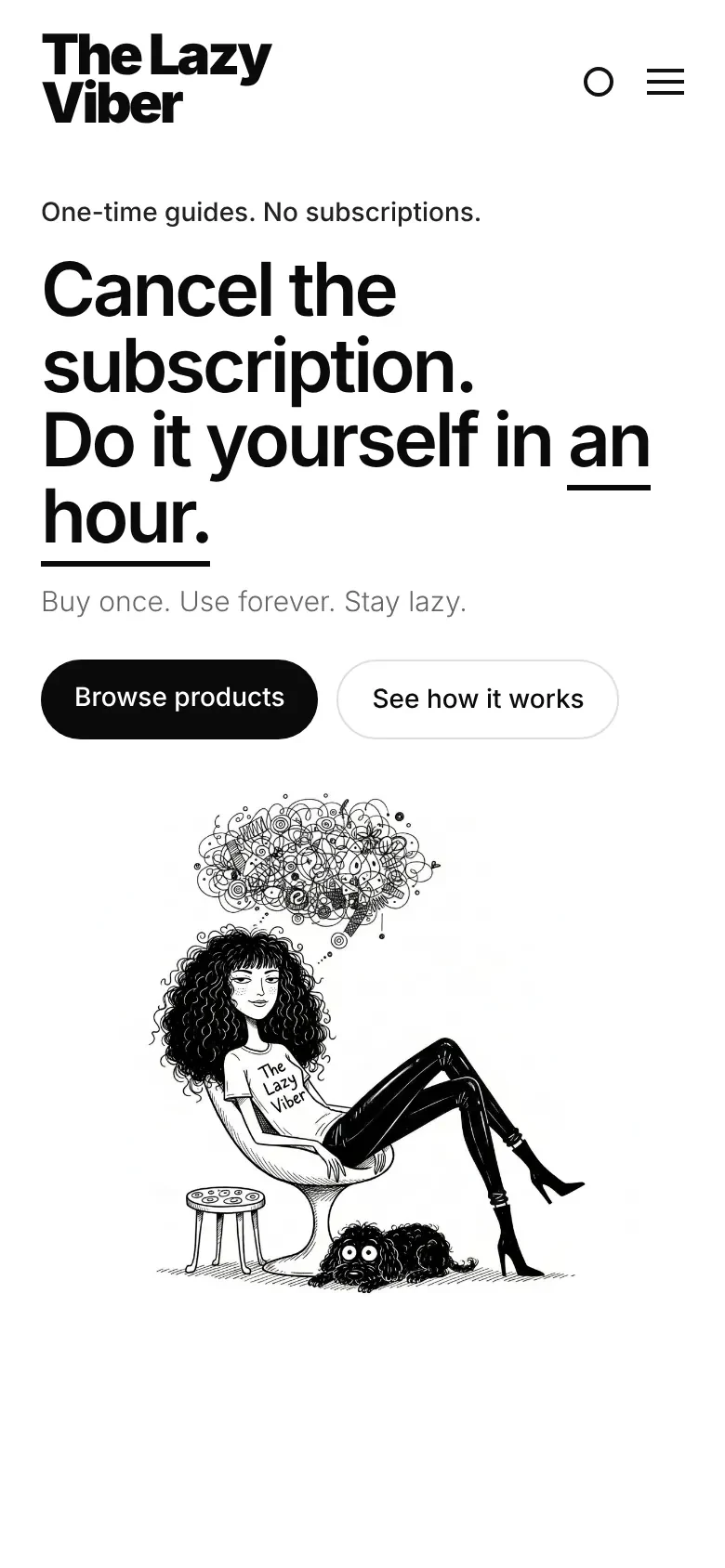
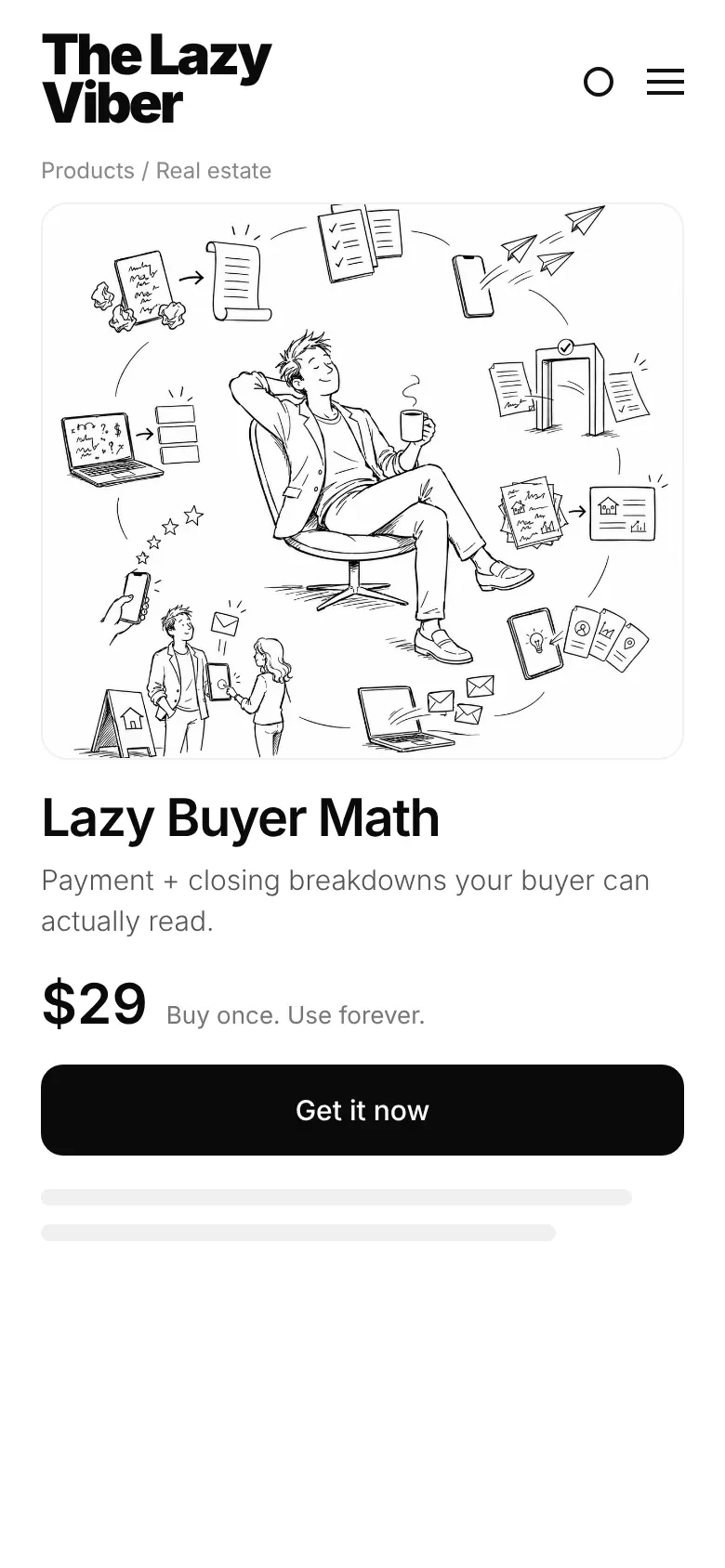
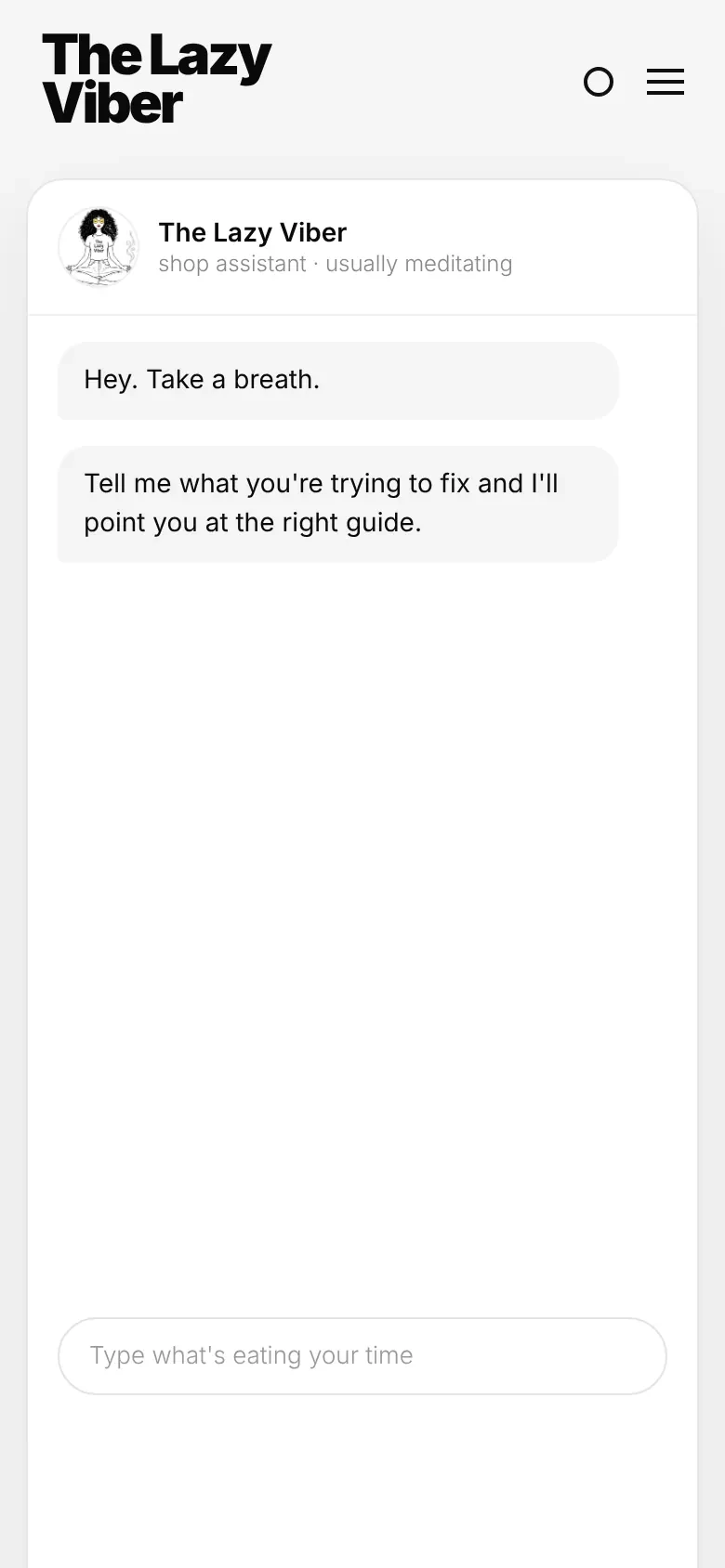
Store screens, redrawn.
Taste is the first decision.
Black ink on white paper, one typeface to read and a hand for the asides, and one colour in the whole house: a red lip.
I set those rules before I made a single product. A brand this strict can be produced by a pipeline and still look like one person drew every page.
03 How my mind works
Three rules. Each one earned by a decision.
This is how I architect anything I build, for the store or for you. Tap a rule to see the decision behind it.
-
- The decision
- Lazy Buyer Math, a guide for agents, is paired with the tool that pulls this week’s mortgage rates with citations, because a payment estimate built on last year’s numbers is wrong on arrival. A writing guide gets a different tool, for a different reason, stated on the page.
- And the assistants
- Each assistant answers from its own shelf only. The one that serves coders never answers a bookkeeping question, so it never answers one badly.
- In your office
- Reading a contract, checking a figure and writing to a client are three different jobs. They go to three different tools, and you can see which one did what.
-
- The decision
- A test shopper caught the assistants quoting prices that had drifted from the shelf. Now every price an assistant says is read from the same catalog the checkout charges from. Nobody retypes a number, so nobody can mistype one.
- No discounts on a single guide
- A single guide is never discounted. Savings live only in bundles, and the saving is the sum of the guides minus the bundle price: the Realtor Bundle is $149 against $321 bought one by one.As of October 2026, from the store catalog.
- In your office
- Every figure in a CMA, a net sheet or a builder comparison opens to its math and its source. If it can’t show where it came from, it doesn’t reach the page.
-
- The decision
- Early on, every finished page published itself, one at a time, and each one paid for its own release. The bill noticed before I did. So I separated making from publishing: the system only drafts, and nothing goes live until I see the full list of what changed and release it as one batch.
- The standard
- Helpers diagnose and propose; they never act on their own. And the controls are built so that someone with no technical background, an eighteen-year-old, could sit down and keep the business running.
- In your office
- Nothing reaches your client, your buyer or your closing table without a person signing off. The speed is the system’s. The judgment stays yours.
- The harness is everything around the model that isn’t the model.The instructions, the skills, the checks and the folders. Before a task begins, the system already knows where it is, who it works for and what done looks like.
- A good harness on a modest tier beats no harness on the most expensive one.The setup is the multiplier; the model is only the engine. When a better model arrives, it drops into the same harness and the work improves the next morning.
- Ai is brilliant on Tuesday and wrong on Wednesday.It sounds just as sure on both days. The harness doesn’t make it less uneven. It makes every miss catchable before it reaches a client.
- The right tier for each step.Sorting, tagging and formatting go to the quickest, lightest tier. Most writing and planning go to the everyday tier. The deepest tier is saved for judgment calls, when nobody yet knows what good looks like.
- Every miss becomes a check.Fix the harness, not just the output, and the same mistake can’t come back. That is what turns the misses from catastrophic into boring.
In Florida Realtor
The magazine called it harness engineering: building structured environments around Ai models. Plainly, not the prompt but the structure around it, so the work comes out right every time and not only on a good day.
Read the full essay (opens The Lazy Viber in a new tab)On The Lazy Viber journal. Opens in a new tab.
04 The orchestration
Seven roles. One gate.
When a tool changes, the guide regenerates; nothing ships without her approval.
06 · The human gate
Me. I see the full list of what changed and release it as one batch, or I don’t.
Tap any role in the map.
Every product moves through the same roles in the same order. Tap a role to see its job.
It starts with something people pay for every month and resent. One brief: who it’s for, and what it replaces.
Drafts the guide, the step-by-step setup and the templates from that one brief.
Reads every line for tone and for fact. A line that sounds like a pitch, or can’t show its source, goes back.
Seven languages, each in the way people actually speak it, never the textbook version.
Ink drawings in the house style, then the motion and the walkthrough.
Me. I see the full list of what changed and release it as one batch, or I don’t.
On the shelf in every language, readable by search and by answer engines, and already known to the shop assistant.
05 Watch it run
One guide, idea to shelf.
Lazy Buyer Math, a guide for agents whose buyers can’t read a payment sheet, moving through every role.
01 / 07 · Idea
A pain people pay for.
Agents hand buyers a spreadsheet. The buyer still can’t tell what they’re bringing to closing.
“A spreadsheet handoff isn’t a conversation.”
From the guide, as published
02 / 07 · Writer
The writer drafts.
One brief becomes the guide, the setup steps and the templates.
Lazy Buyer Math
Payment + closing breakdowns your buyer can actually read.
03 / 07 · Reviewer
The reviewer pushes back.
A line that sounds like a pitch, or can’t show its source, goes back to the writer.
- Sounds like a person
- Every number has a source
- Says plainly what it replaces
04 / 07 · Translator
Seven languages, spoken.
Each language in the register people actually use. One line from the guide:
English
Rates move week to week.
The original
05 / 07 · Illustrator
The illustrator draws.
Ink on white, in the house style, for every guide.

06 / 07 · The human gate
Then it waits for me.
I see the full list of what changed and release it as one batch, or I don’t.
Ready to publish
- Guide pageNew
- Translations7 languages
- IllustrationNew
- Assistant answers7 new
Released by Maysoon
07 / 07 · Published
On the shelf.
Live in every language, findable by search and answer engines, and already known to the shop assistant.
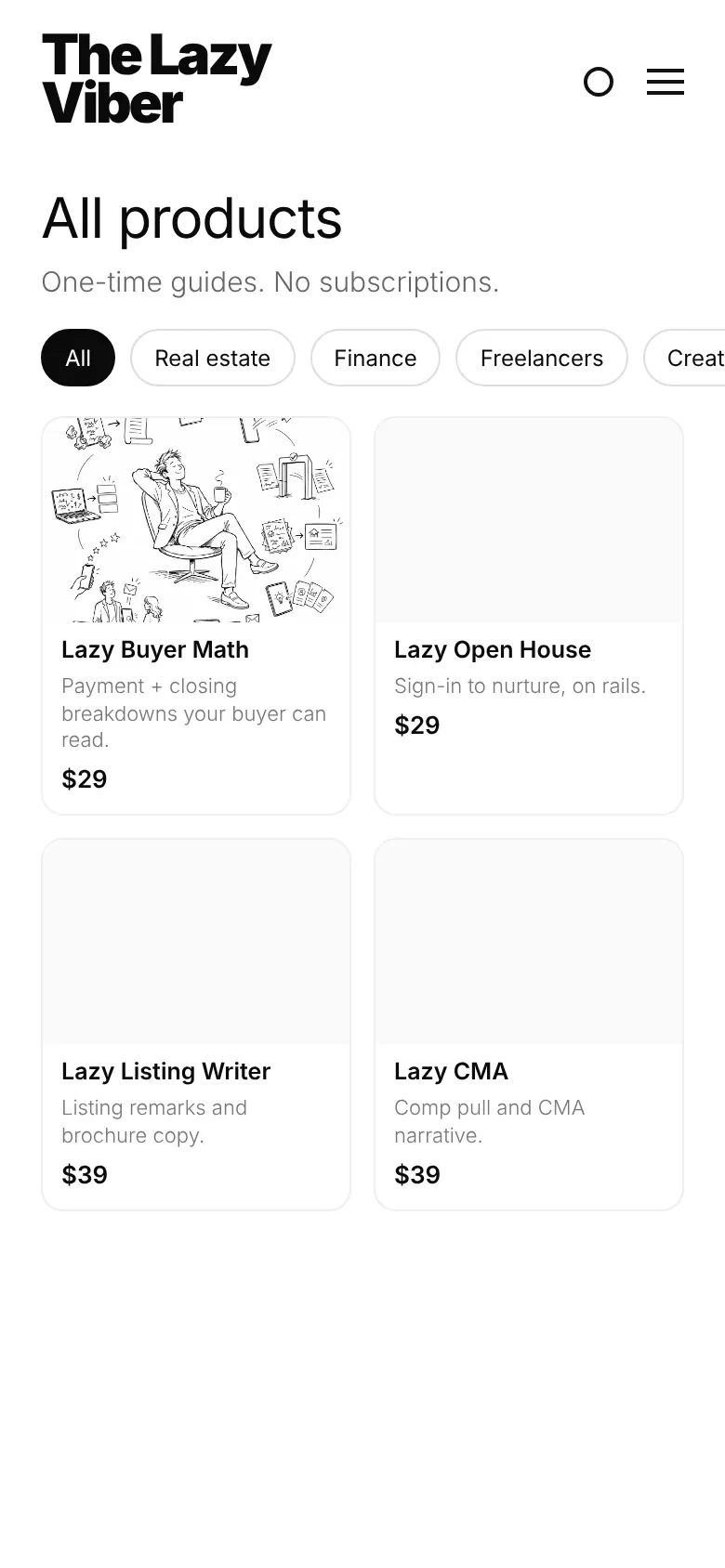
Lazy Buyer Math is $29 on the live store ↗. Translation and answer counts are as of October 2026, from the store catalog. Store screens, redrawn.
06 Self-regenerating
What runs on its own, and what waits for me.
The line between the two is the whole design. Anything repeatable runs itself. Anything that is a decision stays with a person.
- AnswersAdd a guide to the catalog and seven questions and answers write themselves in the house voice. The assistant uses them in its very next conversation.
- TranslationsNew pages go out in seven languages, each in the way people speak it.
- The assistant’s shelfIts list of guides, and every price it quotes, is read from the catalog. It can’t recommend what isn’t there or quote what it doesn’t cost.
- Buyable, or not yetA guide becomes buyable the moment its checkout exists. The shelf never promises what the store can’t deliver.
- UpdatesWhen a tool changes, the guide regenerates. The buyer paid once; the guide keeps up.
- PublishingNothing goes live until I release the batch.
- PricesEvery price is a decision. No system changes one.
- New linesA college line and a kids’ line are built and waiting, unlisted, until I decide they launch.
- FixesHelpers diagnose and propose. I approve, or I don’t.
- A new assistant’s voiceWhat a new assistant knows about its own shelf, I write by hand.
As of October 2026, from the store catalog.
07 Try it live
“Hey. Take a breath.”The shop assistant’s first words
The assistant is live on the store. Tell it what you’re trying to fix and watch it choose one guide from the shelf, at the shelf price. Its voice belongs to the store: drier and funnier than mine, on purpose.
Talk to the shop assistant (opens The Lazy Viber in a new tab)
Opens The Lazy Viber in a new tab.
08 Coming soon
A program, coming soon
The Forward Deployed Envoy.
For real estate agents who want to pivot their career into deploying Ai systems inside the offices they already know, using the same method you just watched run.
- Brokerages
- Builders
- Title offices
Coming soon. This opens a short note to me, and I reply personally.
09 What this means for you
The same method, in your office.
Your listing launch, your CMA and your follow-up run as one pipeline: drafted by the right tool, every figure tied to its comp, released by your broker.
Every community, plan and incentive gets its own pages and its own answers, in the languages your buyers speak, with prices read from your price sheet, never retyped.
Every file explained to the buyer, the seller and both agents from the file itself, each figure traceable to its line, and nothing sent without your closer’s sign-off.
By paying you agree to the Terms.
What this is, and isn’t
- Education and hands-on implementation help. Not legal, tax, accounting or compliance advice; for those, ask your attorney, accountant or broker.
- Results vary. Figures on this page illustrate the method unless a source is cited beside them.
- You own your decisions and anything you publish or send. A person on your side reviews Ai output before it reaches a client.
- You stay responsible for your brokerage’s policies, MLS rules, state licensing rules, Fair Housing law and the terms of the platforms you use.
- Nothing here creates a brokerage or agency relationship. That only starts with a signed written agreement.